Eliades Ochoa | Live @ Casa de la Trova

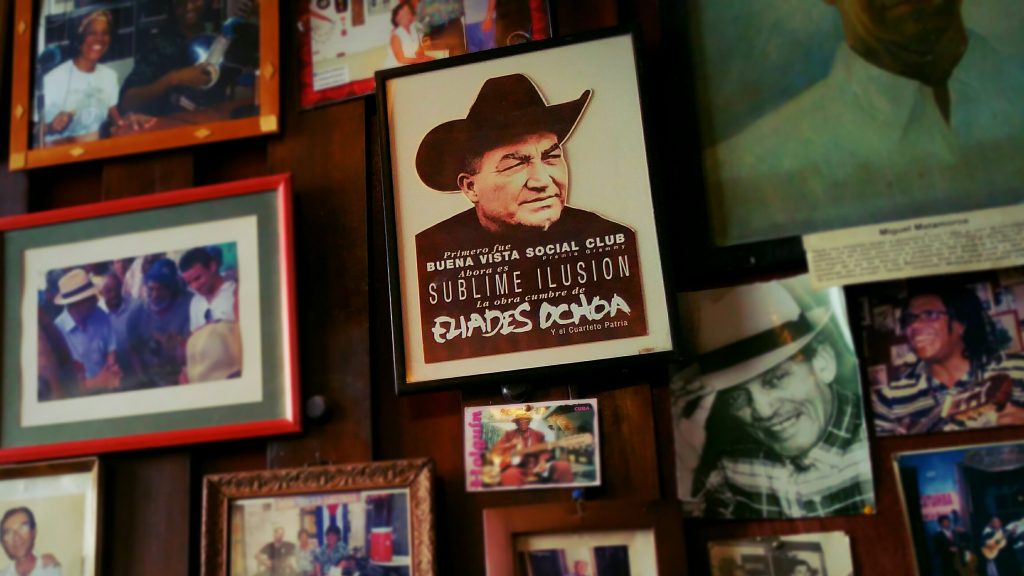
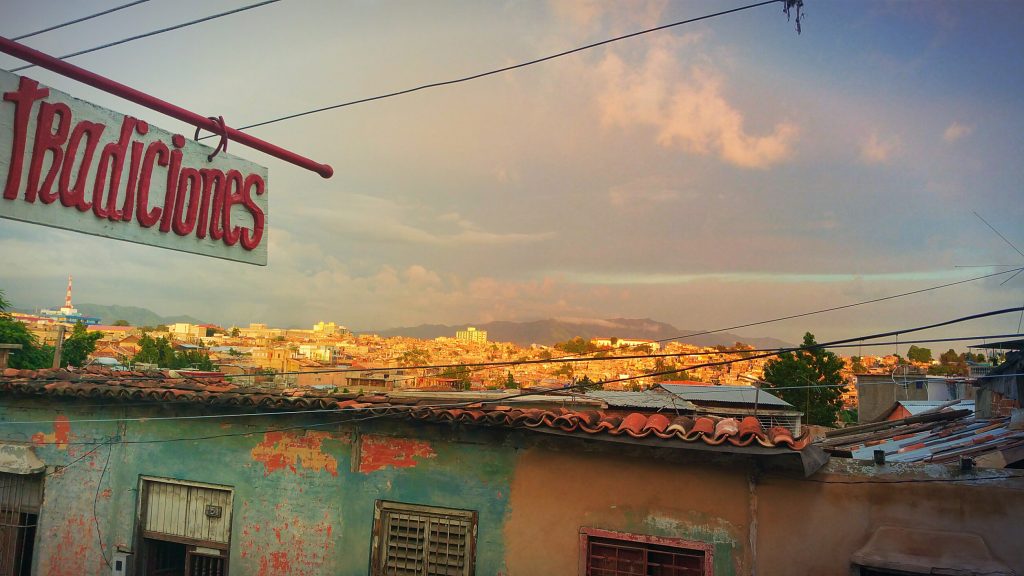
I’ve been invited to the Casa de la Trova to see Buena Vista Social Club guitarist & singer Eliades Ochoa, play live in his home city of Santiago de Cuba.
I head off to meet my teacher, the casa’s resident trovadora, Xiomara Vidal. This is my big chance to get up, close and personal with Eliades’ unique guitar style.
I spot Xiomara at the entrance and she wastes no time, escorting me past the door staff with aplomb, as I make a world record attempt for head bowing.
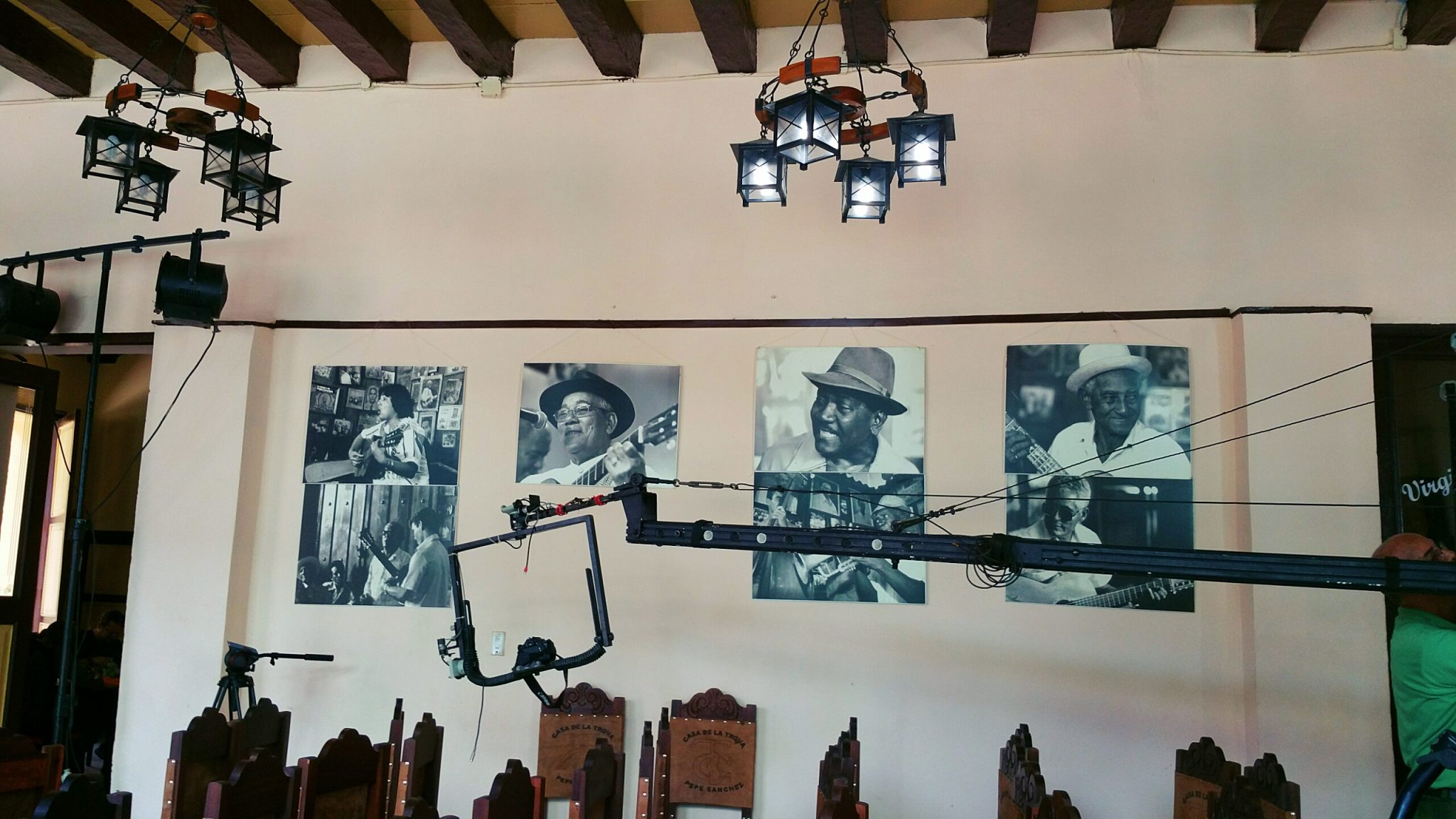
She leads me into the main room, where there are ornate chairs decked out and I spot a picture of her on the wall next to her contemporaries. The opposite wall is open to the street, all but for the bars sealing it off. Half of Santiago de Cuba is piled up against them and inside a film crew is busy adjusting cranes with swivelling arms.
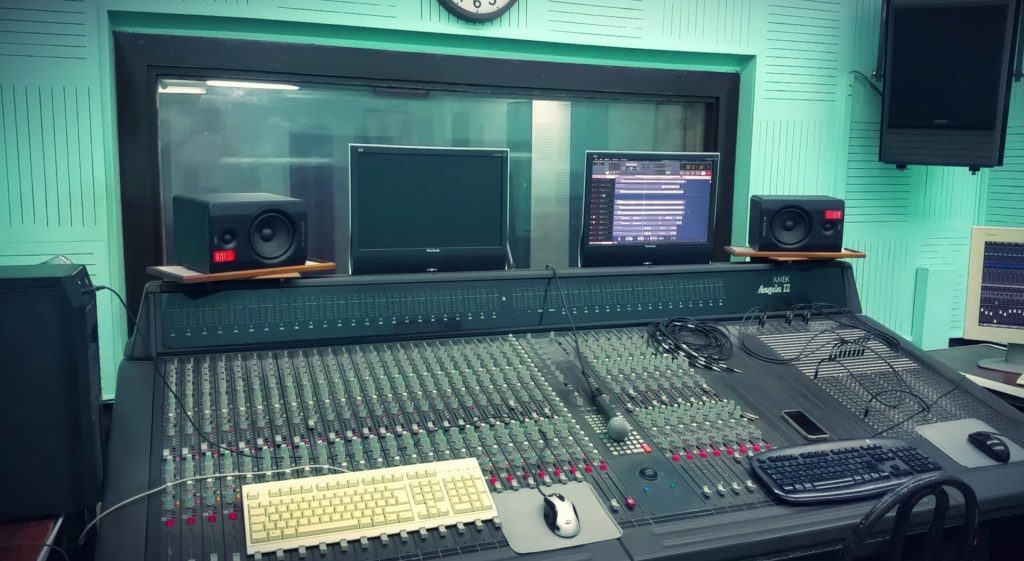
Xiomara tells me a film studio is making a documentary about him.
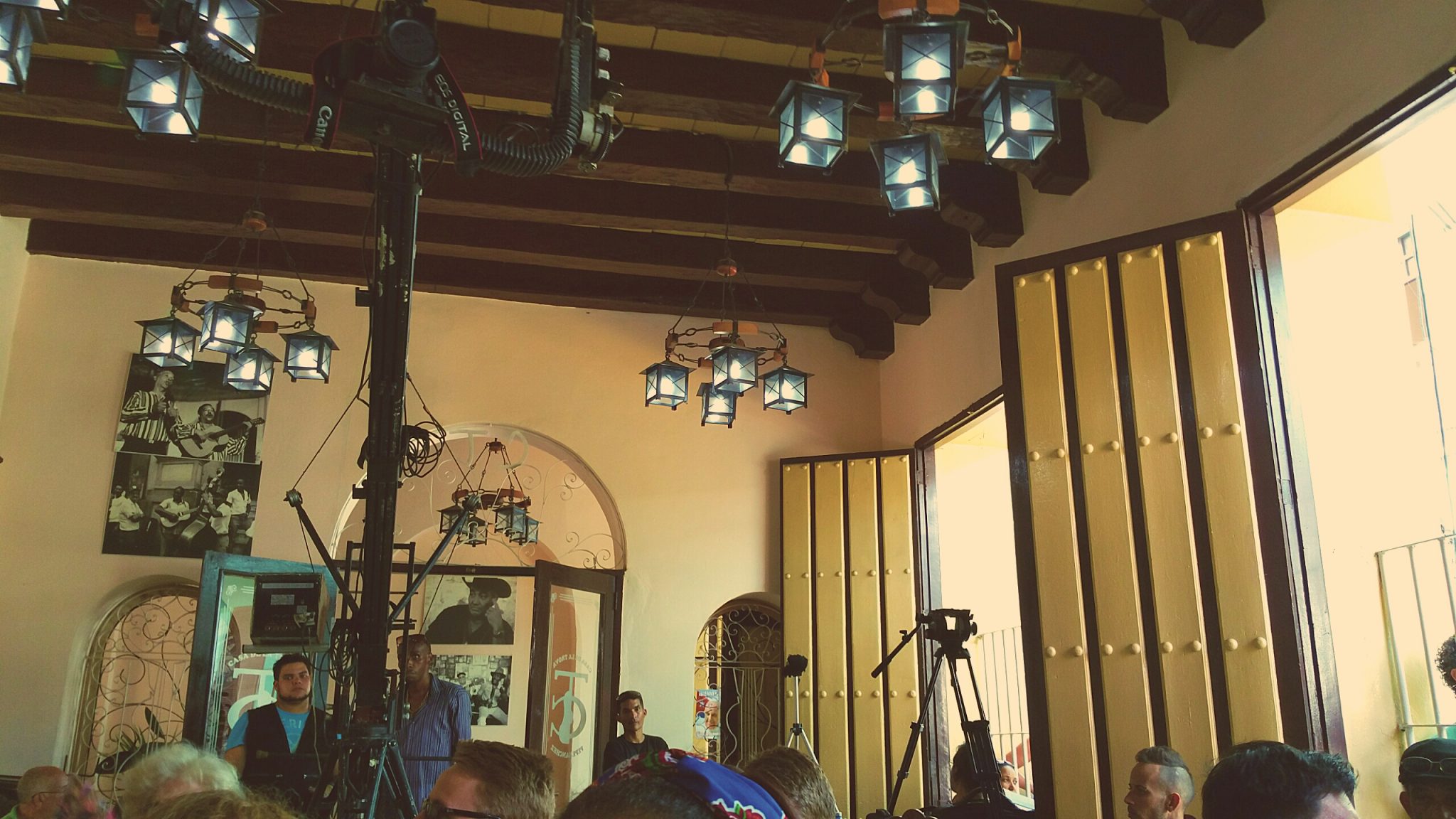
I continue to follow Xiomara as she saunters down the aisle, with her guitar slung over her shoulder, right up to the front row. She stops, turns and signals for me to take the the middle seat.
I try to act ‘tranquilo’ but I’m struggling to contain my excitement. And at the same time, I can’t help wondering when the doorman is going to realise that he has made some kind of mistake and turf me out.
The Rise of Eliades Ochoa
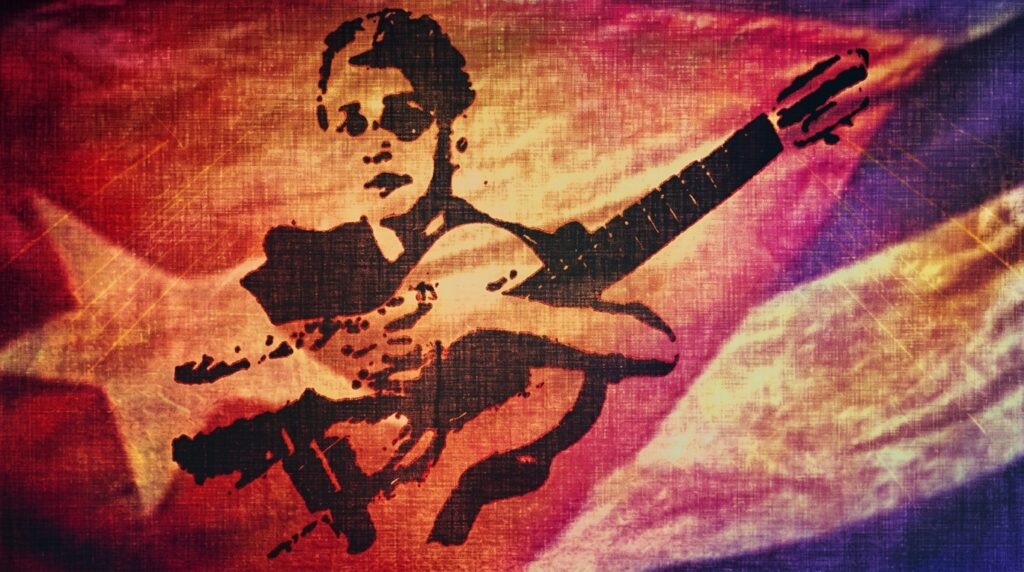
Eliades Ochoa first discovered his enduring chemistry with the guitar at the age of six.¹ He was born in the countryside near Santiago de Cuba and continues to wear his signature cowboy hat.
He recounts how he used to learn new songs by ear back in the ’50s:
“You would hear something live or on the radio that you liked and you would search through the Victrolas, the jukeboxes in the bars, until you found the song. Then, when you had a medio (five centavos), you would go back, drop your coin in and listen – intently.”¹
Busking & Banter
He began busking aged 11, once serenading the great singer, Benny Moré, as his shoes were being shined. Moré said: “All the good ones start like this”. ²
He later played in houses of ill repute, where I suspect he developed his quick, dry wit.
Casa de la Trova
Around 1968, he caught the attention of the newly-opened Casa de la Trova and began work there.
Here, as ‘a lad amongst old-timers’, he was able to develop his traditional trova style with its masters.
Cuarteto Patria
In 1978 he accepted an invitation to assume the leadership of Cuarteto Patria but insisted on adding son to its repertoire.
He also expanded the percussion section, citing that: “Without the African ingredient, the genre loses its verve.”¹
Eliades, Compay & their Adapted Guitars
Fusing the Guitar and the Tres
In 1986, Eliades met Compay Segundo and invited him to join the quartet. Compay brought with him his song ‘Chan Chan’ that would later become Buena Vista’s stand-out track and substitute national anthem.
This pair of guitarists sounded so different to anyone else because they had both customised their guitars to suit their own styles. They added strings to create harmonised pairs, like the tres cubano (Cuban instrument with 3 double strings, derived from the Spanish guitar.), and adjusted their pitches.
Compay’s ‘Armónico
Compay Segundo invented a guitar/tres hybrid which he called the armónico. It harnesses the best qualities of each, as he demonstrated here:Eliades’ Guitar/Tres
I’m not sure how much Eliades was influenced by Compay’s invention but he says the following about his adapted guitar.
“I grew up playing the guitar, but with the sound of my dad playing the tres, which has a much flintier sound and carries further.
“They go hand-in-hand in Cuban country music and to get that sound in one, I add two extra strings and put the third and fourth strings close together so I can fast pick them and get a great tres sound.”³
Perhaps Eliades has perfected Compay’s original idea somehow?
Tonight I’ve got a front row seat to hear Eliades’ unique guitar sound live and direct.
A Gringo in the Midst
The venue slowly starts to fill up and the film crew grow more edgy. I’m just trying to absorb it all.
Xiomara wakes me from my daydream and says, in her inimitable dry tone, ‘You know what’d be lovely now?’ ‘Err, que?’, I reply goofily. ‘A cervecita‘ (a little beer – by which we mean: a strong can of Bucanero). I kick myself for not offering first and get myself to the bar quick-sharp.
When I return, she asks if I could film the gig with my phone. Again, I am only too happy to oblige. So, if you ever watch the documentary and see a gringo on the front row with a camera in one hand and a Bucanero in the other, that’ll be me.
Let The Show Begin…
The band enter to applause from inside and outside the venue as Eliades greets old friends. This place is like a second home for him, and to add to the family feel, his brother Humberto and son Elgis flank him on either side of the stage.
There’s a slight technical hitch with Eliades’ guitar amplification as they are about to begin. But they dive straight into ‘Pena’ nonetheless, as all good Cubans would. Eventually the scrambling sound man resolves the problem, having lost a few litres of sweat.
They continue with a mixture of original songs and Cuban standards: ‘Saludo Compay’, ‘Estoy Como Nunca’, and the extremely catchy ‘Pintate Los Labios Maria‘.
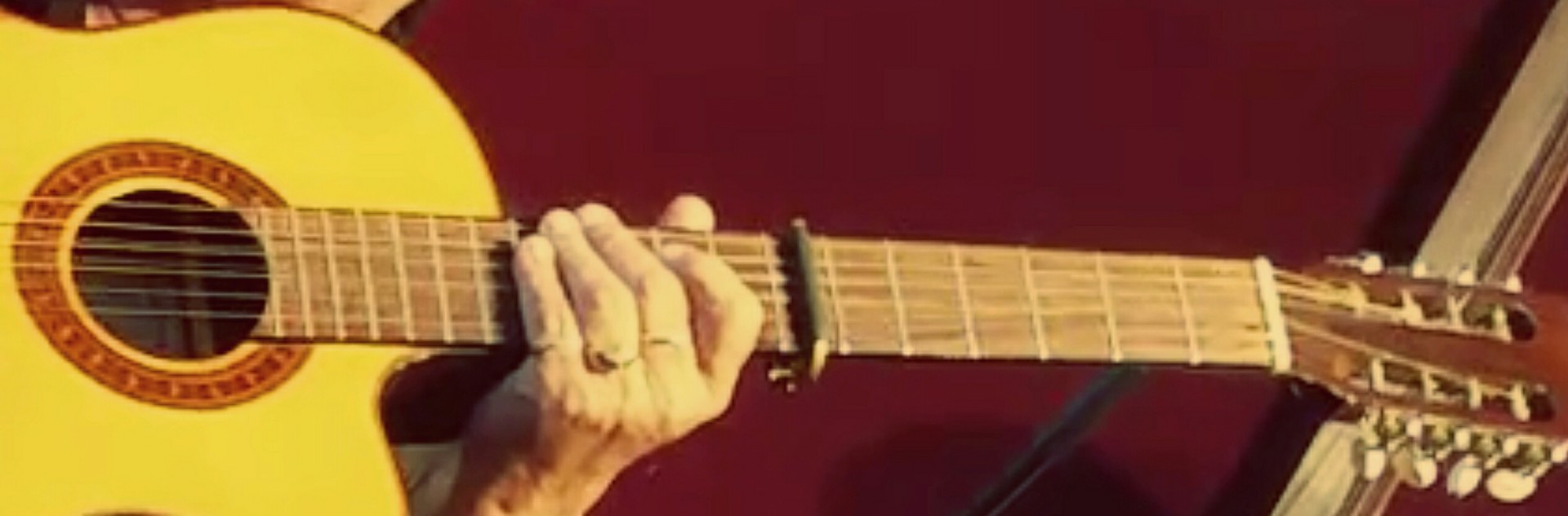
From here, I can see just how much Eliades focuses on those two middle pairs of strings he has. You can just about make them out in the picture below, as well as the 8 tuning heads on the right, instead of the usual 6.
He nearly always uses a capo. I think, whereas Compay raised his bottom 3 strings by an octave to help them cut through melodically, Eliades uses a capo which also gives him the option to remove it and still have a standard guitar feel.
It’s clear that he is eager to help the next generation of Cuban musicians, having enlisted two youngsters on trumpet and bass.
‘Que trompeta!’, Xiomara shouts just before the interval, prompting Eliades to bring the trumpeter to the front to take a bow. The bassist also gets an extended solo during ‘Estoy Como Nunca’.
They return after the interval with some other tracks featured on the Buena Vista album, ‘Chan Chan’ and ‘Carretero’. Eliades gives us a heartfelt introduction to ‘Chan Chan’, to commemorate the life of his friend Compay, who has passed on.
The house dancers energise the space between us and the stage. A young lad throws some shapes with typical, seemingly innate, Cuban swagger. At one point he slacks a little and Xiomara urges him on: ‘Baila, baila!’. He knows what’s good for him, so he snaps back into action.
‘El Cuarto de Tula’ (‘Tula’s Room’)
There’s one particular classic that has been conspicuous in its absence: ‘El Cuarto de Tula’. This is another of Cuba’s most popular son tracks, also featured on the Buena Vista Social Club album.
Eliades now summons all dancers, and what follows is reminiscent of an English football pitch invasion, but with slightly more grace and flair. Then, a lady who is very well endowed in the derriere department begins to block my camera’s view of Eliades’ handiwork. Xiomara directs me to stand in order to maintain a clear shot.
I remind her that the director clearly told everybody at the beginning of the gig not to stand up during the performance. But on second thoughts, as the young lad did earlier, I decide to do as I’m told. I’d fancy my chances better against the director than Xiomara!
The show comes to a close and Eliades leaves the stage to rapturous applause. The director signals ‘that’s a wrap’, but it’s not over just yet.
Meeting Eliades Ochoa & Gabino Jardines
Xiomara turns to me and asks if I would like to meet Eliades. ‘Si, Señor!’ I say (the Bucaneros now affecting my choice of words). So off she waltzes me into his backstage den, has a word in his assistant’s shell and waves me over.
I’m trying to figure out something worthwhile to say – in Spanish – but the moment gets the better of me. I can see he’s visibly tired, wiping the Santiago heat from his teaming brow, so I keep things short and sweet, complementing him on his work on AfroCubism and his custom guitar. We get a photo taken together, I shake his hand and thank him for his time.
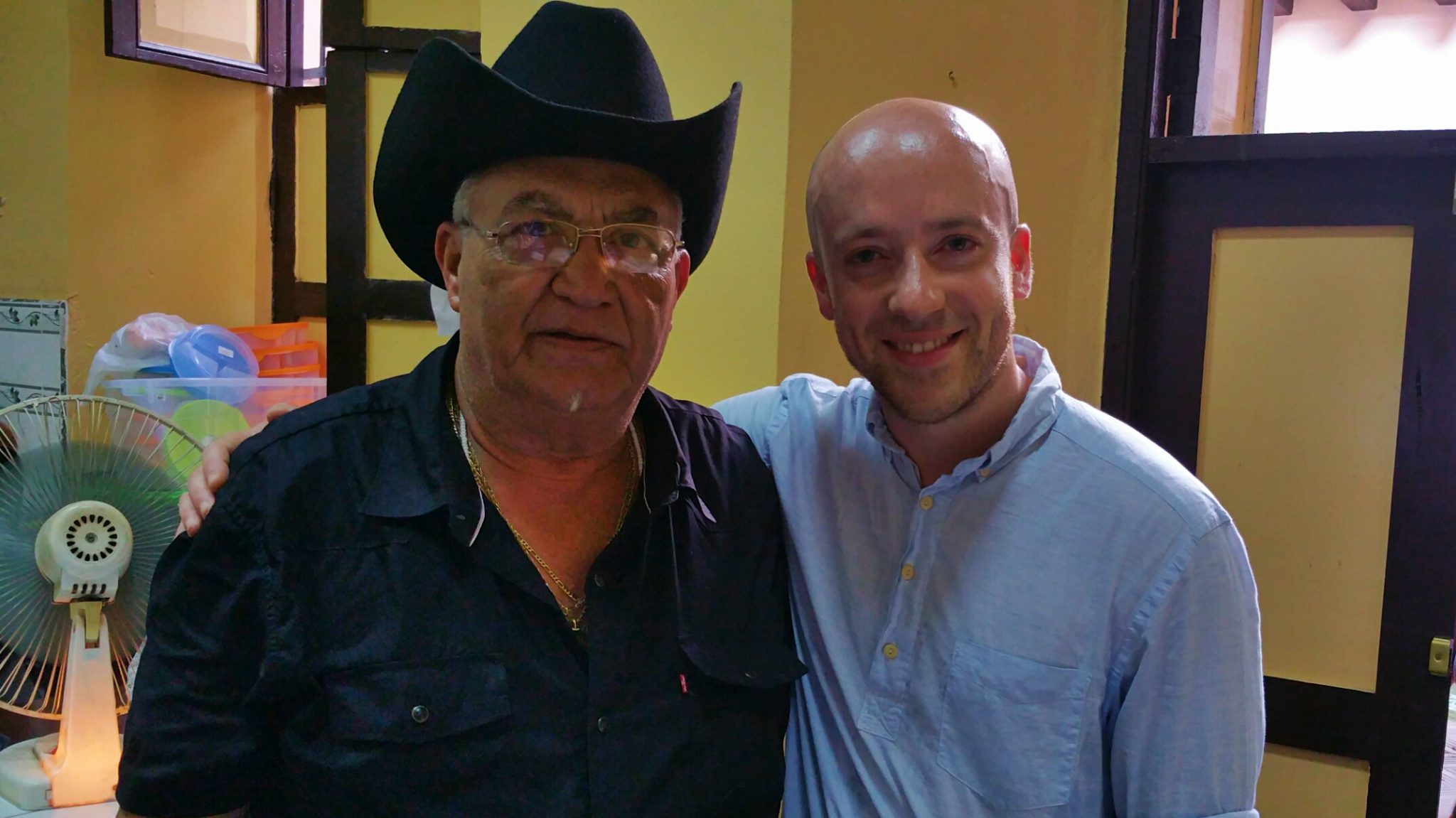
Xiomara and I spend the rest of the night sitting with two other Santiagueran guitarists, Gabino Jardines and David Bell Vega. We sit in the inner courtyard of the Casa de la Trova trading songs on her guitar.
Time flies and before we know it, we’re the only ones left. The barman turns off the lights but the gang continue as if nothing has happened.
Gabino and Xiomara give us a final bolero.
After his rather slick guitar performance in the dark, complete with vocal harmonies, Gabino brushes it off modestly.
We call it a night and I arrive back at my digs with a bag full of memories and a trip to Egrem Siboney recording studio to look forward to…
Further Listening: The Curator’s Appendix
Live at Casa de la Trova
Experience the raw, unpolished magic of Eliades Ochoa performing in his element at the legendary Casa de la Trova. This essential playlist captures the acoustic resonance of his signature guitar/tres hybrid, offering a masterclass in traditional Cuban son and the rhythmic drive that made him a global icon.
Guantanamera: Street-Level Syncopation
Jumping straight to the 3:38 mark, this segment of the global Playing For Change collaboration strips away the studio polish to witness the profound street-level musicianship that defines Cuban culture. It is a visceral demonstration of how traditional acoustic instrumentation weaves complex, infectious grooves effortlessly into daily life.
Todo el Mundo es Música
Dive into the heart of Santiago de Cuba’s musical ecosystem with this evocative documentary excerpt. Beginning at the 17-minute mark, the film explores the deeply ingrained social role of music in Cuban society, highlighting the communal gatherings and spontaneous street performances that keep the Trova tradition fiercely alive.
Citations